One of the biggest logistical questions about full-time RV living is this:
How do you handle mail, packages, and a permanent address when you don’t actually live anywhere full-time?
Even though your RV is your home, you still need a legal domicile for driver’s licenses, vehicle registration, insurance, banking, voting, and yes — even jury duty.
Choosing the right state for full-time RV domicile isn’t just about taxes. It affects how easy your life will be on the road.
We’ve established domicile twice — first in South Dakota and later in Texas — and the difference between the two experiences taught us a lot about what really matters.
If you’re trying to decide where to establish residency or wondering how mail forwarding works as a full-time RVer, this guide will walk you through what we’ve learned, what worked, what didn’t, and why we ultimately chose Texas.
- What Is RV Domicile?
- Our First Domicile: South Dakota
- Another Big Reason We Left South Dakota
- Moving Our Domicile to Texas
- Jury Duty as a Full-Time RVer (Real Experience)
- How Mail Forwarding Works for Full-Time RVers
- How We Handle Packages on the Road
- Texas Domicile Checklist for Full-Time RVers
- Frequently Asked Questions About RV Domicile
- Final Thoughts on Choosing a Domicile
This post contains affiliate links. As a participant in Amazon Associates and various affiliate programs, we are compensated when qualifying purchases are made through our referral links at no additional cost to you. Full Disclosure
What Is RV Domicile?
Your domicile is your legal home state. It’s the state that considers you a resident, even if you’re physically somewhere else most of the year.
It determines:
- Where you vote
- Where you register vehicles
- What driver’s license you carry
- How taxes apply to you
- Where you could be called for jury duty
Full-time RVers typically choose from a handful of RV-friendly states — most commonly Texas, South Dakota, or Florida — because they:
- Have no state income tax
- Allow mail forwarding addresses
- Make residency relatively straightforward
But here’s the part most people don’t talk about:
Not all RV-friendly states feel RV-friendly once you’re living it.
Our First Domicile: South Dakota
When we first went full-time, we chose South Dakota. We used Your Best Address in Sioux Falls as our legal address and officially became South Dakotans.
At the time, it looked ideal:
- No state income tax
- Easy residency requirements
- Quick DMV process
- Popular among RVers
On paper, it checked every box.
Where It Started to Wear Thin
Over time, things shifted.
There were efforts to pass legislation that made it harder for full-time RVers to vote — especially those without traditional housing. That didn’t sit well with us.
But the bigger issue was jury duty.
The county where we were domiciled wanted us to physically return to South Dakota for jury duty — even though we were living full-time out of state.
If you live in a house, that’s reasonable.
If you’re thousands of miles away in an RV? That becomes expensive and disruptive fast.
South Dakota stopped feeling flexible. And when you live on the road, flexibility matters.
Another Big Reason We Left South Dakota
This part doesn’t show up on comparison charts — but it mattered more than we expected.
We spend a lot of time in Texas through seasonal work and workamping opportunities.
Winter stays, and travel routes that just naturally brought us back.
South Dakota?
We rarely went back.
That created friction.
If something required us to be physically present in South Dakota — licenses or jury duty — it meant a major detour.
Texas aligned with our actual travel patterns.
That alignment reduced stress more than any tax benefit ever could.
Moving Our Domicile to Texas
We transferred our domicile to the Escapees RV Club in Livingston, and we’ve been much happier since.
Escapees RV Club is a vibrant community of RV enthusiasts, offering educational programs and social events where like-minded adventurers can come together. From resources to discounts, we make life on the road easier, more affordable, and filled with unforgettable experiences!

Texas has a long history of working with full-time RVers. It doesn’t just tolerate the lifestyle. It understands it.
Why Texas Has Worked Better for Us
- No state income tax
- Clear residency process
- Established legal framework for full-time RVers
- Reasonable handling of jury duty
- We’re physically in Texas every year
That last point can’t be overstated.
Jury Duty as a Full-Time RVer (Real Experience)
This is where the difference became obvious.
In South Dakota
- Expected us to return
- Limited flexibility
- Created uncertainty

In Texas
We’ve been selected twice.
- First time: We explained we were full-time RVers and out of the area. We were dismissed without issue.
- Second time: We happened to be nearby, so I went in person — and was dismissed there as well.
Texas treated the situation reasonably. That’s all we wanted — reasonable.

How Mail Forwarding Works for Full-Time RVers
Once you establish domicile through a mail forwarding service, your mail goes to that permanent address.
From there, you can:
- Have mail forwarded to your current location
- Hold it until you’re ready
- Request scans
- Have junk mail shredded
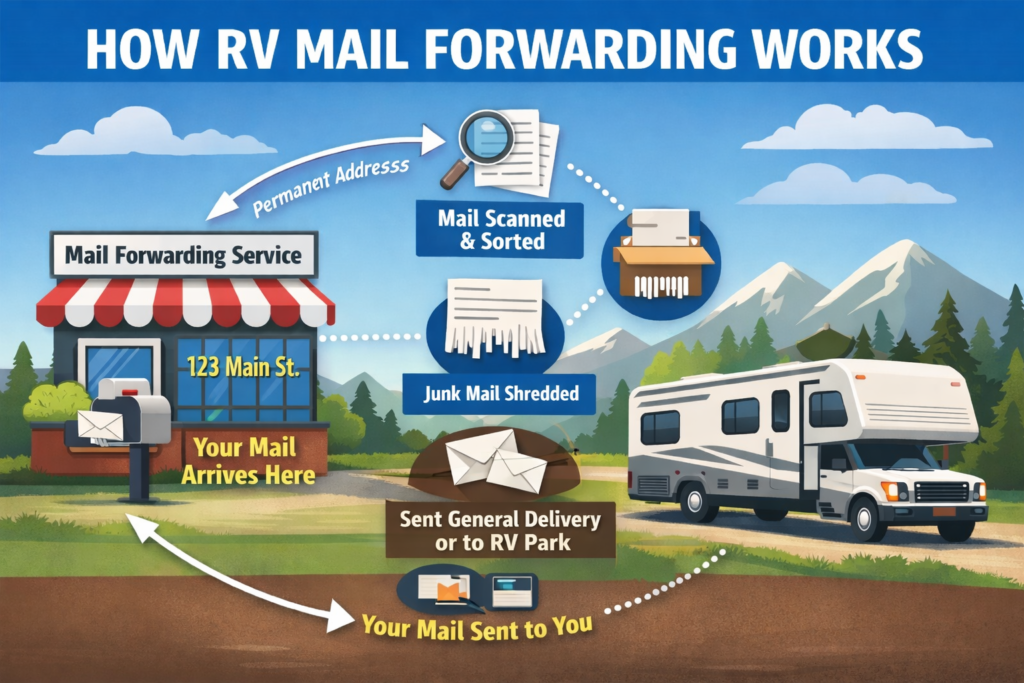
When we need mail sent to us, we use:
- RV parks (always call first)
- General Delivery at post offices
- UPS or FedEx locations
- Friends or family if needed
After a few months, it becomes routine.
How We Handle Packages on the Road
Packages are often easier than mail.
Options include:
- Shipping directly to RV parks
- Amazon Lockers
- UPS Stores
- FedEx Office locations
- General Delivery
The key is always calling ahead. Every campground handles packages differently.
Texas Domicile Checklist for Full-Time RVers
If you’re considering Texas, here’s the practical flow.
1. Set Up Mail Forwarding
Join Escapees and establish your Livingston address.
2. Travel to Texas
You’ll need to be in Texas for a driver’s license in person.
3. Get Texas Driver’s Licenses
Bring required identity documents and proof of residency. Be sure to bring any documents that prove name changes. This is something Lisa needed, showing her name change from her previous married name back to her maiden name and change to our last name.
4. Register Vehicles
Texas no longer requires annual vehicle safety inspections.
Emissions testing only applies in certain major metropolitan counties.
If you’re domiciled in a rural county like Polk County (Livingston), you won’t deal with emissions testing requirements.
5. Update Voter Registration
Register to vote using your Texas address.
6. Update Insurance and Financial Accounts
Auto, RV, health, banking — everything tied to your old address.
7. Update Legal Documents
Wills, trusts, medical directives.
Done in order, it’s straightforward.

Frequently Asked Questions About RV Domicile
What is the best state for full-time RV domicile?
The three most common states for full-time RV domicile are Texas, South Dakota, and Florida because they have no state income tax and allow mail forwarding addresses.
The “best” state depends on your travel patterns, insurance needs, and how each state handles things like voting and jury duty. What works for one RVer may not work for another.
How do full-time RVers get mail?
Most full-time RVers use a mail forwarding service. The service provides a permanent street address where mail is received.
You can then choose to:
- Have it forwarded to your current campground
- Send it General Delivery
- Request scans of important documents
- Shred junk mail
Once you establish a system, it becomes routine.
Can you vote as a full-time RVer?
Yes. Your voting rights are tied to your domicile state. You register and vote using your permanent mailing address in that state.
Some states are more accommodating to full-time RVers than others, so it’s worth researching how your chosen state handles absentee or mail-in voting.
Do full-time RVers have to serve jury duty?
Possibly. Jury duty is determined by your domicile state and county.
Some states allow full-time RVers to request dismissal if they are out of the area. Others may require in-person appearance. Policies vary, which is why this is an important factor when choosing a domicile.
Do you need vehicle inspections in Texas for an RV domicile?
Texas no longer requires annual vehicle safety inspections. Emissions testing only applies in certain major metropolitan counties.
If your Texas domicile is in a rural county like Polk County (Livingston), you generally won’t deal with emissions testing requirements.
Is it hard to change your RV domicile?
Changing domicile requires updating your driver’s license, vehicle registration, voter registration, insurance policies, and financial accounts.
It takes some paperwork and planning, but it’s manageable — and sometimes worth it if your current state isn’t working well for your full-time RV lifestyle.
If you’re just starting out, check our complete guide to RVing for beginners before making major decisions like choosing a domicile.
Final Thoughts on Choosing a Domicile
If you’re researching the best state for full-time RV domicile, you’ll almost always hear the same three names:
- Texas
- South Dakota
- Florida
We can only speak from experience with Texas and South Dakota because those are the states we’ve actually domiciled in.
We’ve heard good things about Florida from fellow full-timers who use it successfully. Many RVers are happy there. But since we haven’t established residency there ourselves, we won’t pretend to offer firsthand advice.
What we can say with confidence is this:
South Dakota worked well in the beginning — until it didn’t.
Texas has aligned better with how we actually live and travel.
And that’s the key.
Don’t choose a domicile based solely on popularity or what someone else says works for them.
Choose one that:
- Aligns with your travel patterns
- Makes legal and logistical sense for your lifestyle
- Treats full-time RVers reasonably
- Reduces stress instead of adding it
For us, Texas checks those boxes.
Your situation may be different — and that’s okay. Just make the decision based on real-world fit, not just a checklist.
Full-time RV living gives you freedom — but that freedom only feels good when the foundation is solid.
Mail, domicile, residency, voting, jury duty — these aren’t the exciting parts of life on the road. But getting them right makes everything else easier.
If you’re just getting started, take the time to choose your domicile carefully. Don’t focus only on taxes. Think about where you actually travel, how flexible the state is, and how it treats mobile residents.
And if you’ve already chosen a domicile that isn’t working? It’s okay to pivot. We did.
Choosing a domicile is one of the most important decisions you’ll make as a full-time RVer — but it doesn’t have to be overwhelming if you go in informed.
Now I’d love to hear from you.
Where are you domiciled — and would you choose it again?
Drop a comment below and share your experience. Your insight might be exactly what another RVer needs to make a confident decision.
And if you found this guide helpful, share it with someone who’s trying to figure out mail and residency on the road.
If you’re looking to build your own home-based business like we have with this webpage, check out Wealthy Affiliate.
Wealthy Affiliate is an all-in-one platform that you can build your whole affiliate marketing business on. It combines training, software, and website hosting into one. This makes the whole process of starting an online business from scratch much easier, especially if you’re new to building a website.