
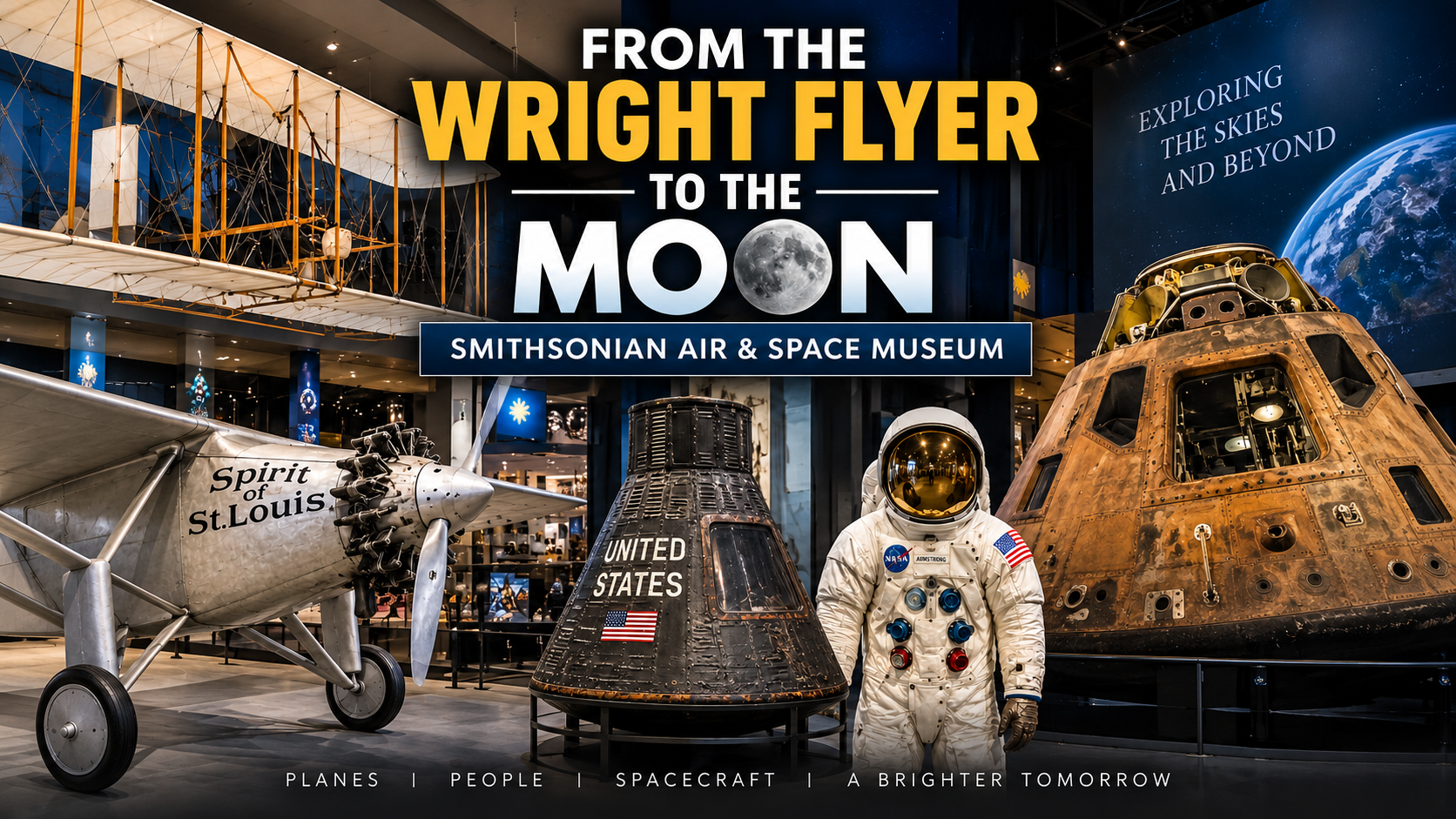
There are some museums you visit because the museum itself is incredible, and there are others you visit because of what is inside.
For me, the Smithsonian National Air and Space Museum in downtown Washington, DC, falls into the second category.
As an aviation enthusiast, I wouldn’t call it the best aviation museum we’ve visited. We’ve been to other aviation museums where I enjoyed the overall layout, the number and variety of aircraft, and the experience of wandering among the planes more.
But when it comes to individual pieces of aviation and space history, the Smithsonian is hard to beat.
During our visit, we stood in front of the original 1903 Wright Flyer. We saw the world’s first military airplane. Charles Lindbergh’s Spirit of St. Louis. Alan Shepard’s Freedom 7. Gemini VII. The Apollo 11 Command Module Columbia. Neil Armstrong’s spacesuit.
These aren’t replicas of famous aircraft and spacecraft.
These are the ones that made history.
And for someone who loves aviation history, that’s what makes the National Air and Space Museum worth visiting.
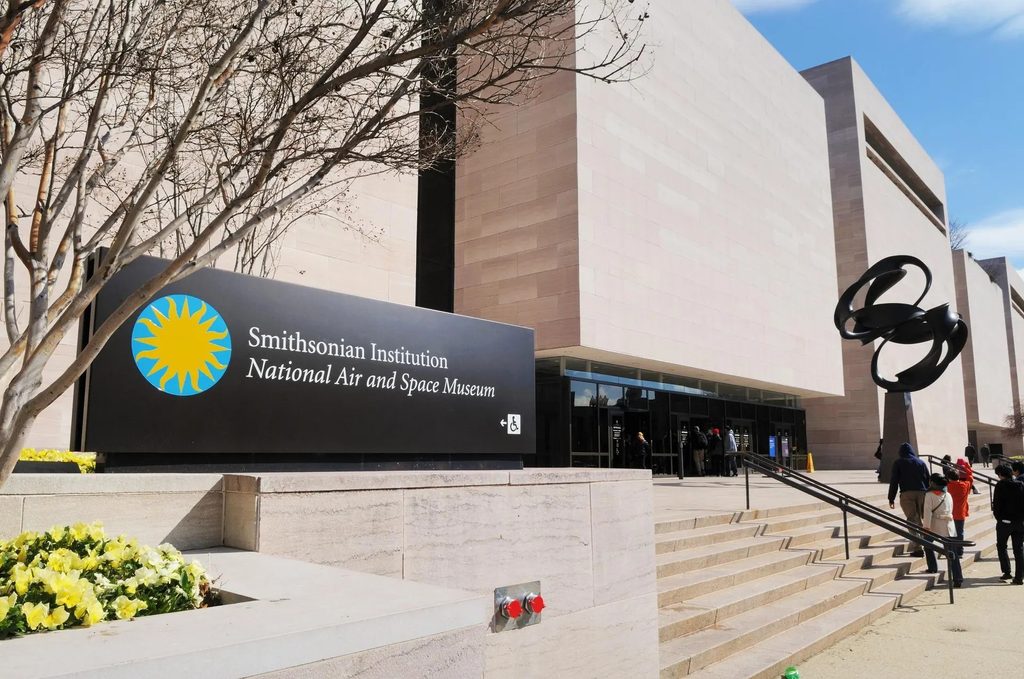
Best Exhibits for Aviation Enthusiasts
If you’re short on time, these are the artifacts that impressed me most during our 2023 visit.
The actual airplane flown at Kitty Hawk.
The world’s first military airplane.
Lindbergh’s actual transatlantic aircraft.
Alan Shepard’s first American human spaceflight capsule.
The suit worn aboard Freedom 7.
Nearly 14 days in that tiny spacecraft.
The command module that went to the Moon and came home.
Worn by the first human to walk on the Moon.
Wright Flyer → Spirit of St. Louis → Freedom 7 → Gemini VII → Apollo 11
- One of the Things That Has Always Amazed Me About Aviation
- The Original 1903 Wright Flyer
- The Wright Military Flyer — Just Six Years Later
- The Spirit of St. Louis
- Then Aviation Became Spaceflight
- Freedom 7 — America’s First Human Spaceflight
- Alan Shepard’s Spacesuit
- Gemini VII — Nearly Two Weeks Inside That?
- Apollo 11’s Columbia
- Neil Armstrong’s Spacesuit
- Where the Smithsonian Loses Me a Little
- A Great Collection Doesn’t Always Mean the Best Aviation Museum
- So Which Is Best?
- From 120 Feet to the Moon—and Beyond
- Know Before You Go: Smithsonian National Air and Space Museum
- More Aviation & Space Adventures From Our Travels
- Our Thoughts After Visiting
- What Piece of Aviation History Would You Want to See?
This post contains affiliate links. As a participant in Amazon Associates and various affiliate programs, we are compensated when qualifying purchases are made through our referral links at no additional cost to you. Full Disclosure
One of the Things That Has Always Amazed Me About Aviation
One of the things that has always fascinated me about aviation is just how quickly humans went from figuring out how to fly to leaving the planet altogether.
Think about where we started.
In 1903, the Wright brothers managed to get a wood-and-fabric airplane into the air for 12 seconds and travel 120 feet.
Just six years later, the U.S. military was buying an airplane.
By 1927, Charles Lindbergh was flying nonstop across the Atlantic.
Within a few decades, jet aircraft were flying faster than the speed of sound.
In 1961, Alan Shepard became the first American in space.
And in 1969—only 66 years after the Wright brothers first left the ground—humans walked on the Moon.
But aviation and aerospace technology certainly didn’t stop there.
We developed the Space Shuttle, a reusable spacecraft that launched like a rocket, orbited Earth, and then returned to land on a runway like an airplane.
Aircraft became capable of flying several times the speed of sound. Stealth technology changed what a military aircraft could look like and what it could do. Computers went from assisting pilots to controlling aircraft that would be extremely difficult—or even impossible—to fly without them.
Then came remotely piloted aircraft and increasingly autonomous systems. Today’s unmanned military aircraft can perform missions that once required putting a pilot directly in harm’s way, while newer systems continue to push toward greater levels of autonomy.
And all of this traces back to 1903.
That’s the part I find almost impossible to comprehend.
For most of human existence, if you wanted to leave the ground, you couldn’t.
Then suddenly we figured it out—and within a single lifetime we were standing on the Moon.
In little more than a century, we went from two brothers experimenting with a fragile flying machine at Kitty Hawk to supersonic aircraft, reusable spacecraft, stealth technology, unmanned aircraft, and increasingly autonomous flight.
It’s crazy when you really stop and think about it.
From 120 Feet to the Moon—and Beyond
The incredible evolution of flight in little more than a century:
From 120 Feet to the Moon—and Beyond
The incredible evolution of flight in little more than a century
Wright Flyer → 1909
Military Aircraft → 1927
Transatlantic Flight → 1940s
Jet Aircraft → 1947
Supersonic Flight → 1961
Human Spaceflight → 1969
Moon Landing → 1981
Space Shuttle → 1980s–90s
Stealth Aircraft → 1990s–Today
Unmanned Aircraft → Today & Beyond
Increasingly Autonomous Flight
In 1903, humans were celebrating a 120-foot flight. Just 66 years later, we were walking on the Moon. Barely a century after Kitty Hawk, aircraft can fly faster than sound, evade radar, operate without a pilot onboard, and perform increasingly autonomous missions.
What will the next 100 years bring?
What’s perhaps even crazier is that we’re still relatively early in the story.
Where does that progression lead over the next 100 years?
I have no idea.
But if the first century of powered flight is any indication, it’s probably going to be something that would sound just as impossible to us today as telling Orville and Wilbur Wright in 1903:
“In 66 years, we’re going to walk on the Moon.”
The Original 1903 Wright Flyer
Of everything I wanted to see at the Smithsonian, the 1903 Wright Flyer was near the top of my list.

There are reproductions of the Wright Flyer in aviation museums around the country.
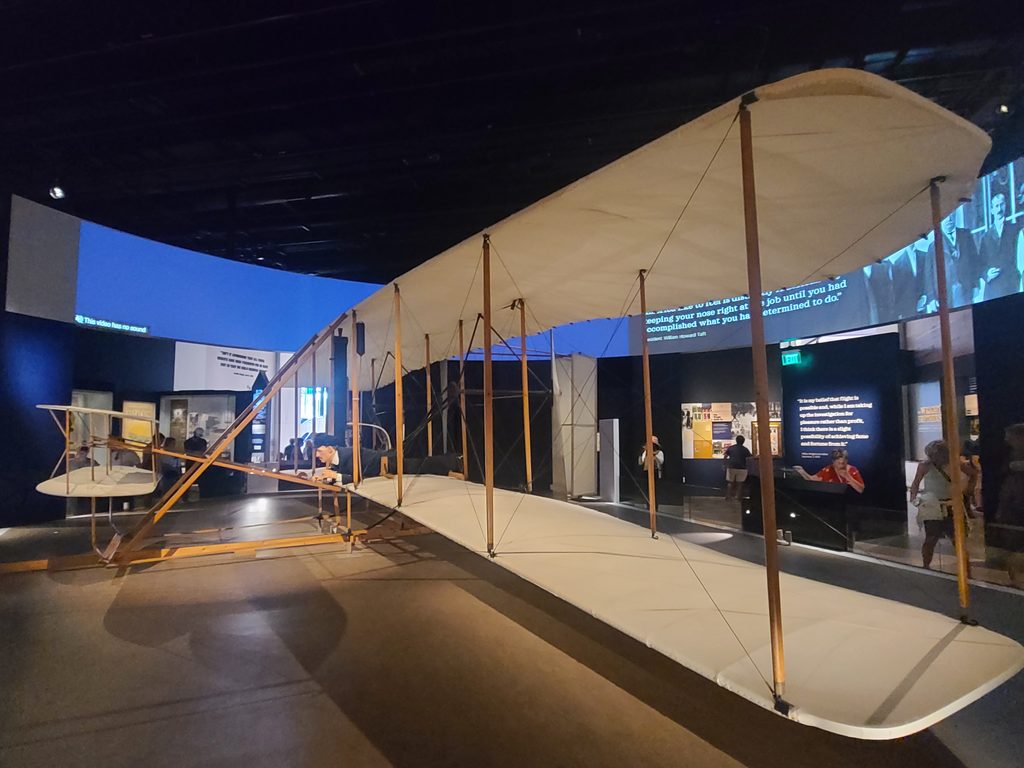
The Smithsonian doesn’t have a reproduction.
It has the airplane.
The actual Wright Flyer built by Wilbur and Orville Wright and flown at Kitty Hawk, North Carolina, on December 17, 1903.
The museum even makes a point of telling visitors:
“This is the Real Wright Flyer.”
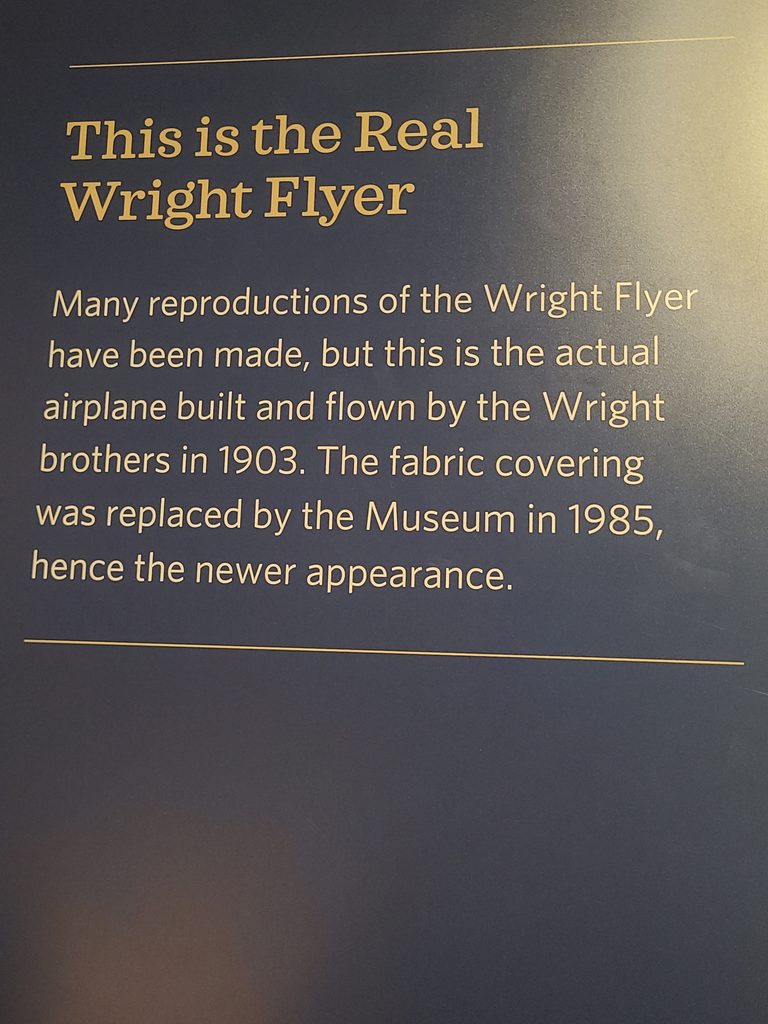
That’s a pretty incredible statement when you’re standing there looking at it.
On its first flight, with Orville Wright at the controls, the Flyer traveled just 120 feet and remained airborne for about 12 seconds. Three more flights followed that day, culminating with Wilbur flying 852 feet in 59 seconds.
Those numbers sound almost insignificant compared with modern aviation.
But those few seconds changed everything.
Our Visit to Dayton Aviation Heritage
Seeing the actual Wright Flyer was especially interesting after learning more about the Wright brothers and their work in Dayton, Ohio.
We visited Dayton Aviation Heritage National Historical Park, where we were able to dig much deeper into the Wright brothers’ story and the years of experimentation that eventually led to powered flight.
I think the two experiences complement each other extremely well.
Dayton tells you the story of how powered flight began. Washington lets you stand in front of the airplane that actually did it.
If you’re interested in the Wright brothers or aviation history, I’d put both places on your list.
The Wright Military Flyer — Just Six Years Later
Not far from the 1903 Flyer is another Wright aircraft that helps put the speed of aviation development into perspective.
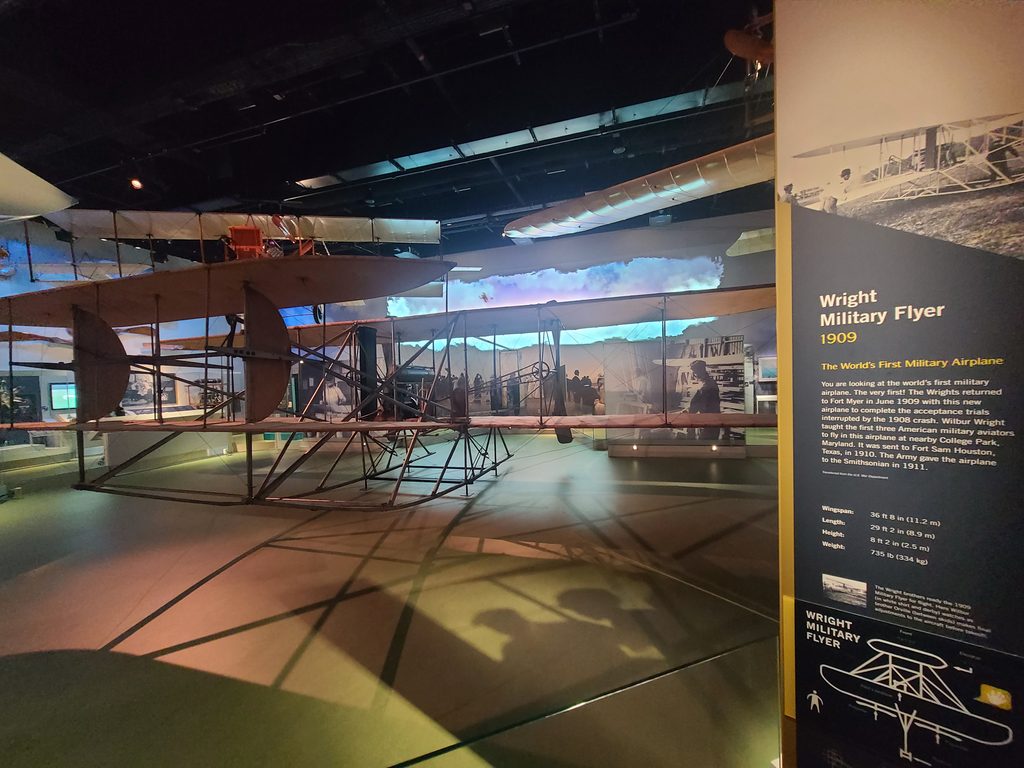
The 1909 Wright Military Flyer became the world’s first military airplane.
Look at the two aircraft and then remember that only six years separate them.
In 1903, the Wright brothers were proving that a powered, controllable airplane could fly.
By 1909, the U.S. Army was buying one.
The Wright Military Flyer was purchased by the U.S. Army Signal Corps after the Wright brothers successfully completed the military’s acceptance trials, becoming Signal Corps Airplane No. 1.
For me, seeing these two airplanes so close together tells the story of early aviation better than a wall full of dates ever could.
Once humans figured out how to fly, things started moving fast.
The Spirit of St. Louis
Then you jump forward another 18 years.
Sitting inside the museum is one of the most recognizable airplanes in aviation history: Charles Lindbergh’s Spirit of St. Louis.
Again, we’re not looking at a replica representing Lindbergh’s flight.
This is the airplane he flew.
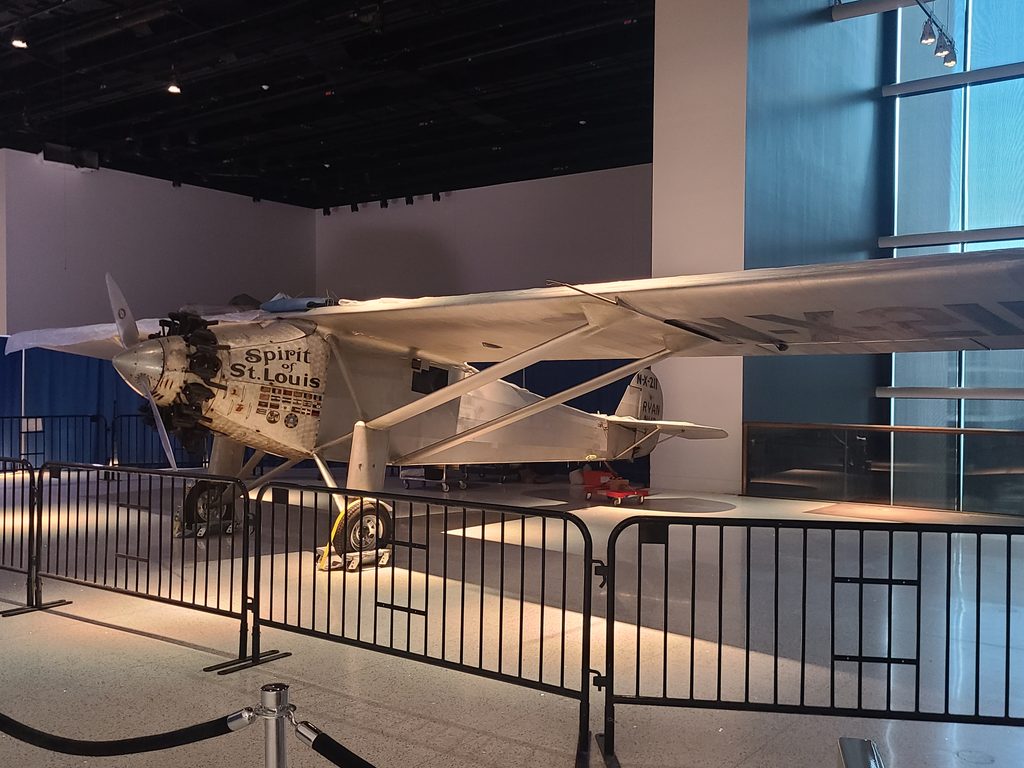
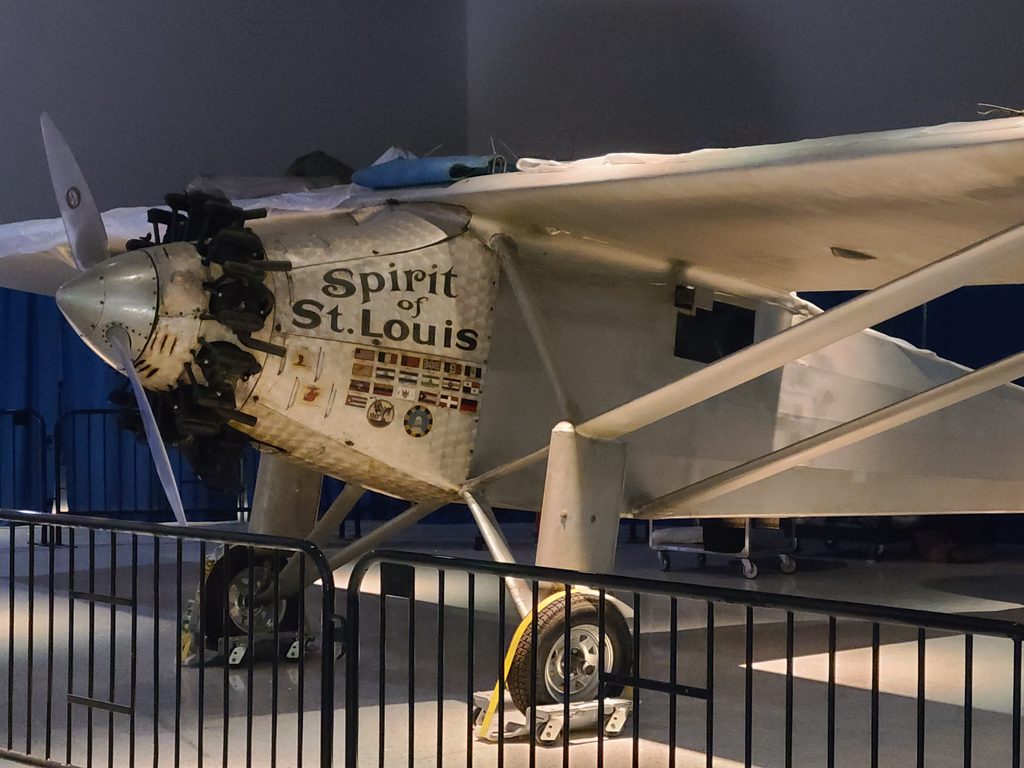
On May 20–21, 1927, Lindbergh flew the Spirit of St. Louis from New York to Paris, completing the first solo nonstop flight across the Atlantic. His flight covered roughly 3,600 miles and lasted about 33½ hours.
Think about where aviation had gone in just 24 years.
In 1903, staying in the air for 59 seconds was an achievement.
In 1927, Lindbergh stayed in the air for more than 33 hours and crossed an ocean.
Standing in front of the Spirit of St. Louis is another one of those moments when you have to remind yourself:
That’s really it.
That’s the airplane that crossed the Atlantic.
Then Aviation Became Spaceflight
For thousands of years humans looked up at the sky.
In 1903, we finally figured out how to fly through it.
Less than six decades later, we were leaving Earth’s atmosphere.
For me, this part of the museum also brought back some childhood memories.
My aviation and space geekery goes way back.
When I was growing up, I wrote to NASA, and they sent me photographs of the Apollo rockets, capsules, and other images from America’s space program. I covered my bedroom walls with them.
Long before I ever imagined I’d someday be standing in the Smithsonian looking at the actual spacecraft, I was a kid staring at photographs of these machines on my bedroom walls.
So walking through the National Air and Space Museum and seeing Freedom 7, Gemini VII, Apollo 11’s Columbia, and the spacesuits worn by Alan Shepard and Neil Armstrong wasn’t just another museum visit for me.
Some of these were the kinds of machines I’d been fascinated with since I was a kid.
And now I was standing right in front of the real things.
That’s pretty hard to beat.
Our travels have given us the chance to explore even more of that history, including our visit to Johnson Space Center in Houston, where we got another look into America’s human spaceflight story.
Freedom 7 — America’s First Human Spaceflight
Alan Shepard’s Freedom 7 Mercury capsule is another artifact I was excited to see.
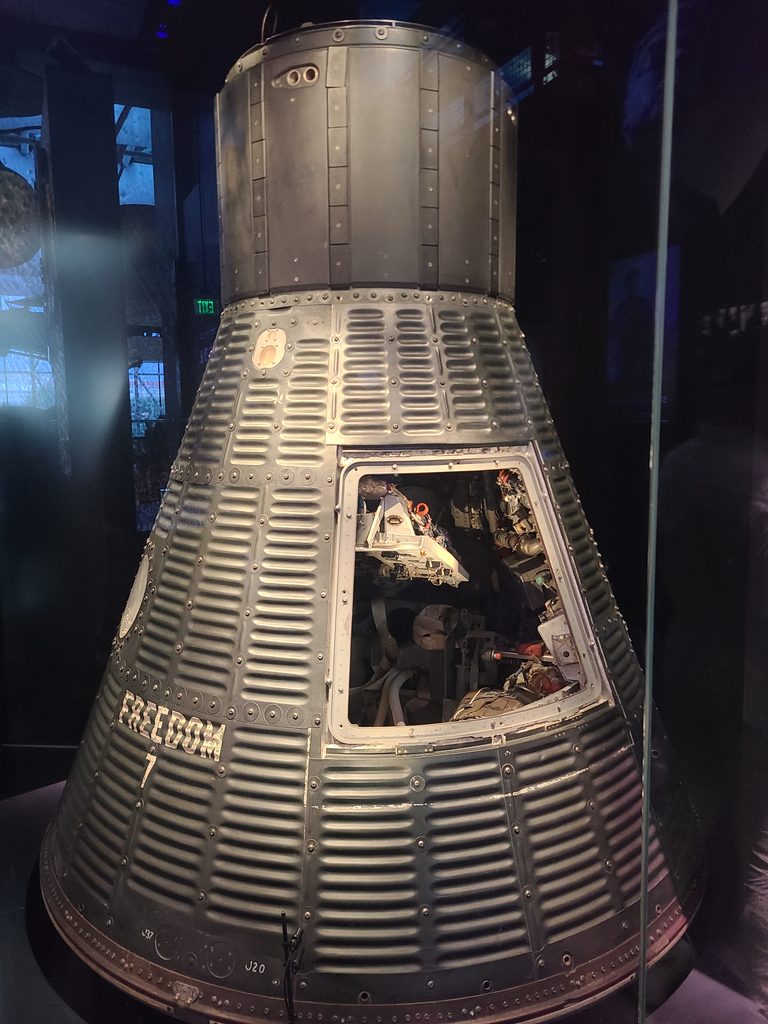
On May 5, 1961, Shepard climbed inside Freedom 7 and became the first American in space.
His suborbital flight lasted just over 15 minutes.
After looking at the capsule in person, however, the length of the flight isn’t what struck me.
Look at how small that thing is.
These early astronauts weren’t sitting inside some spacious science-fiction spacecraft. They were strapped into incredibly cramped capsules surrounded by switches, wiring, and equipment.
Seeing the actual spacecraft gives you an entirely different appreciation for what those early astronauts were willing to do.
Alan Shepard’s Spacesuit
Nearby, we were able to see something that makes the Freedom 7 story even more personal: Alan Shepard’s spacesuit.
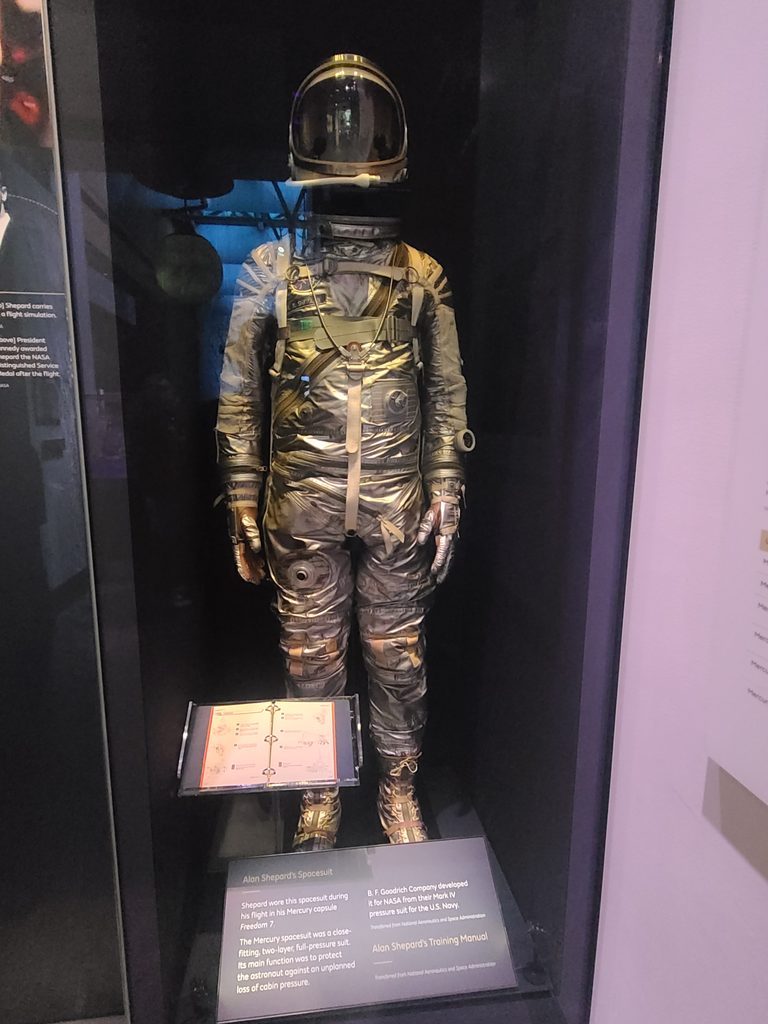
It’s the suit Shepard wore during his Mercury flight aboard Freedom 7.
Again, that’s something the Smithsonian does exceptionally well.
You aren’t simply looking at a Mercury-era spacesuit.
You’re looking at the suit worn by the man who became the first American in space.
When you can see the spacecraft and then see the suit worn by the astronaut who sat inside it, history stops feeling quite so distant.
Gemini VII — Nearly Two Weeks Inside That?
Then there was Gemini VII.
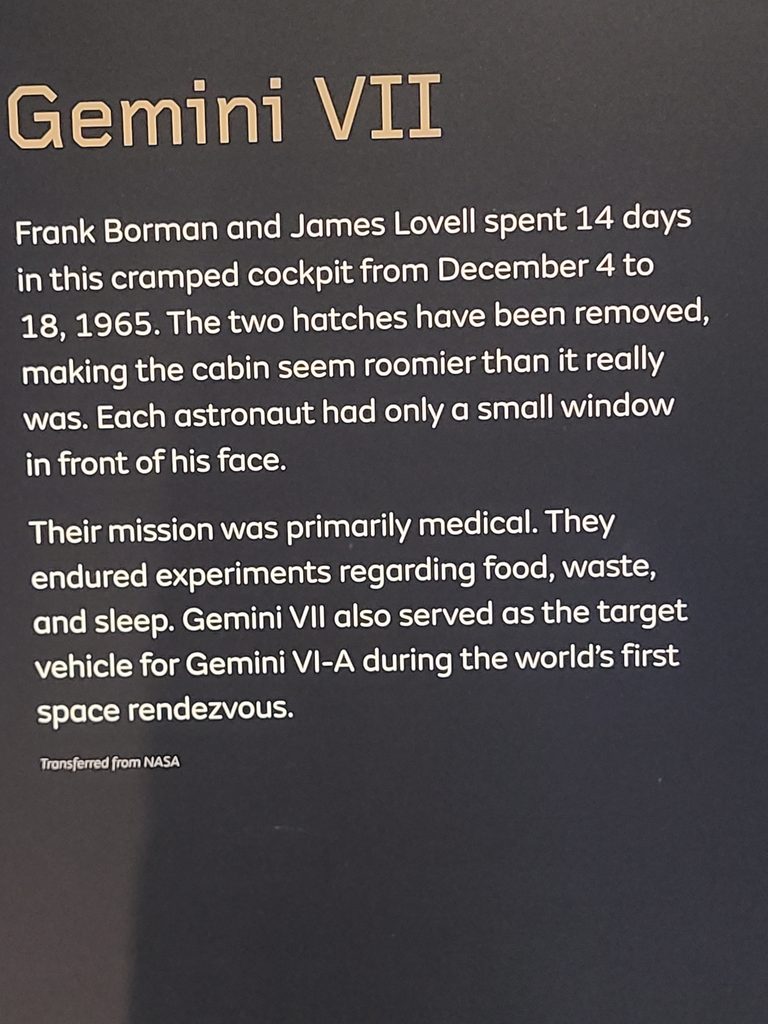
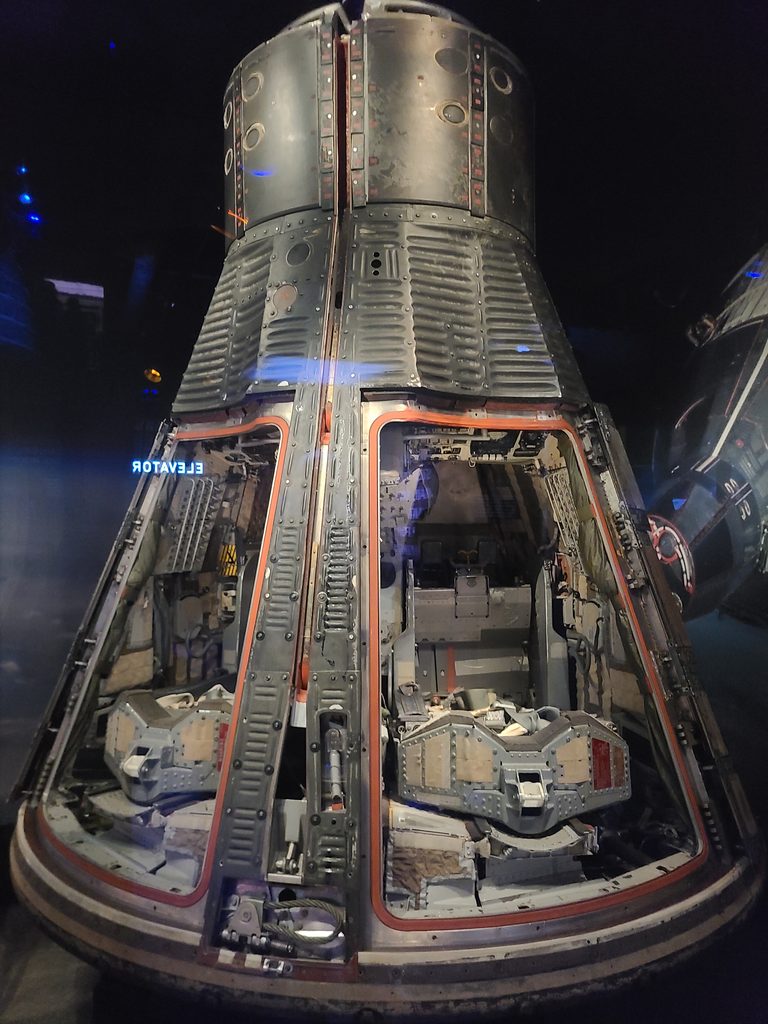
If Freedom 7 looks cramped, take a good look inside Gemini VII.
Frank Borman and Jim Lovell launched aboard Gemini VII on December 4, 1965, and spent nearly 14 days in space, establishing an endurance record at the time.
Lisa and I have lived full-time in an RV since 2019, so we’re pretty accustomed to living in a small space.
Gemini VII takes downsizing to an entirely different level.
I can’t imagine spending nearly two weeks inside that capsule with another person.
No walking outside.
No stretching your legs.
No campground.
And definitely no slide-outs.
Looking inside Gemini VII and seeing just how little room Borman and Lovell had was one of those exhibits that made the accomplishment seem even more impressive.
Apollo 11’s Columbia
Then you arrive at one of the greatest artifacts in the entire museum.
Columbia, the Apollo 11 Command Module.
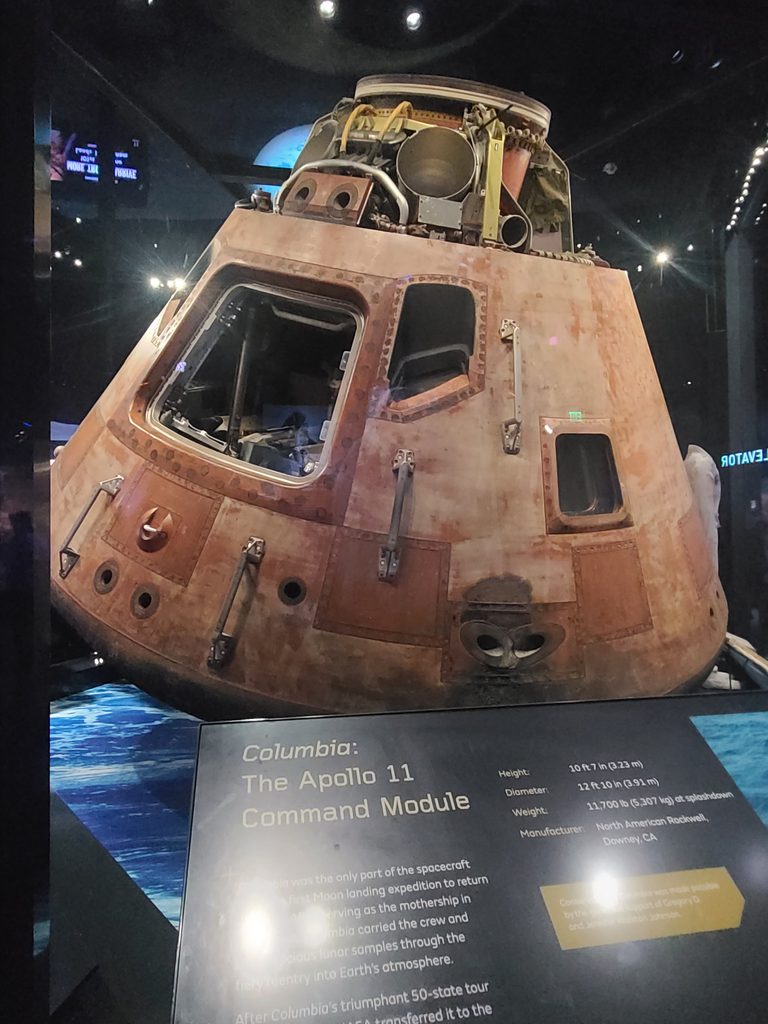
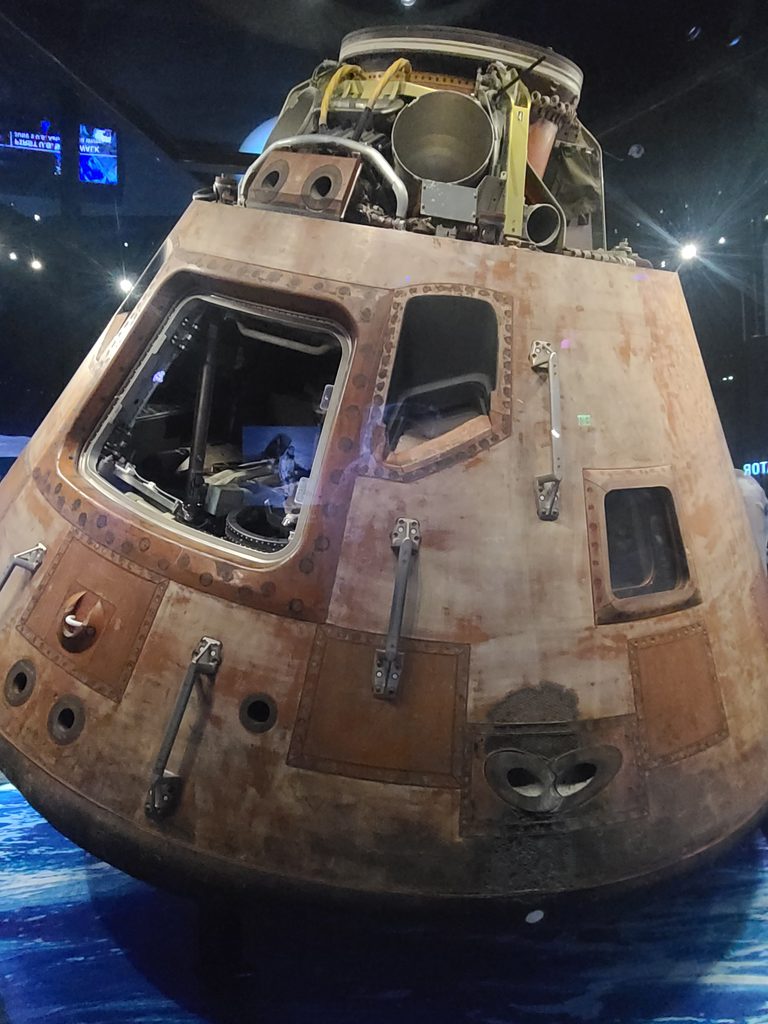
This is the spacecraft that carried Neil Armstrong, Buzz Aldrin, and Michael Collins during the Apollo 11 mission and returned them safely to Earth after humanity’s first landing on the Moon.
Apollo 11 launched on July 16, 1969. Armstrong and Aldrin landed the Lunar Module Eagle on the Moon on July 20 while Collins remained aboard Columbia in lunar orbit. The three astronauts returned to Earth on July 24.
One of the things I like about seeing Columbia in person is that it looks like it has been somewhere.
It isn’t shiny.
It isn’t pristine.
The exterior is discolored and scarred from its journey and fiery reentry through Earth’s atmosphere.
It looks used because it was used.
That battered little spacecraft traveled to the Moon and came home.
Neil Armstrong’s Spacesuit
And then there’s Neil Armstrong’s spacesuit.
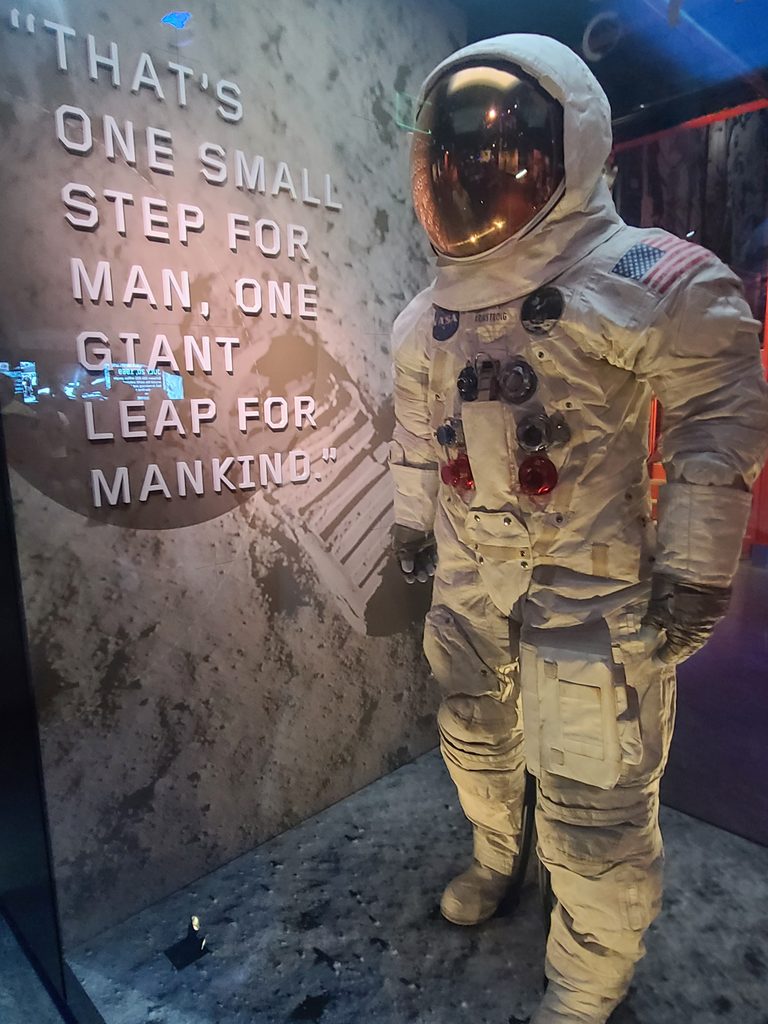
Standing beside it is one of the most famous quotes associated with human spaceflight:
“That’s one small step for man, one giant leap for mankind.”
Whether you’ve been interested in aviation and spaceflight your entire life or barely know anything about the Apollo program, it’s difficult not to appreciate what that suit represents.
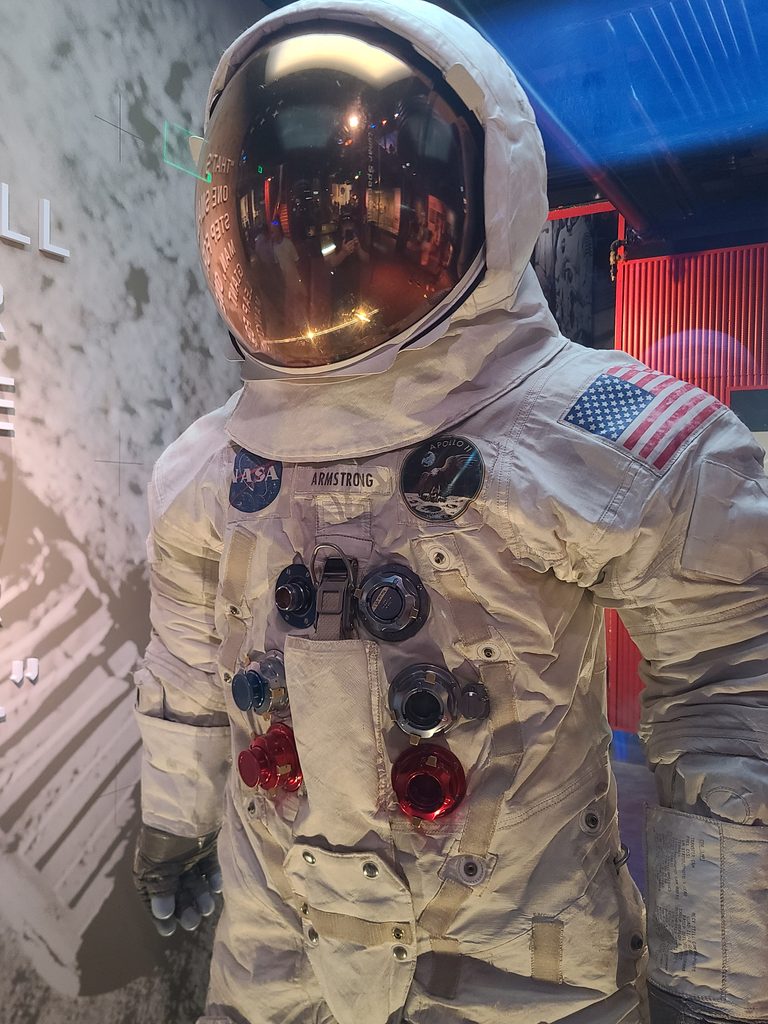
And this is where I find myself going back to the Wright Flyer.
The Wright Flyer first flew in 1903.
Neil Armstrong walked on the Moon in 1969.
Only 66 years separated them.
There were people alive when Armstrong stepped onto the Moon who had already been adults before the Wright brothers ever left the ground.
That absolutely amazes me.
Where the Smithsonian Loses Me a Little
This is also where I’ll probably differ from some visitors.
The National Air and Space Museum mixes some pop culture into its aviation and space collection, including a full-size X-wing from Star Wars and the Star Trek USS Enterprise studio model.
I’m sure plenty of visitors love them.
They’re just not why I visit an aviation museum.
I can do without the X-wing fighter and Enterprise.
Give me another historic airplane.
I understand the argument for including them. Science fiction has influenced generations of engineers, pilots, astronauts, and scientists, and it’s certainly part of our cultural fascination with flight and space exploration.
But as an aviation enthusiast, if I have a choice between looking at a fictional spacecraft and seeing another piece of actual aviation history, I’ll choose the real aircraft every time.
That’s simply what interests me.
A Great Collection Doesn’t Always Mean the Best Aviation Museum
Calling the Smithsonian National Air and Space Museum one of the best aviation museums in the world seems almost automatic.
After all, look at what’s inside.
The original Wright Flyer. The Spirit of St. Louis. Freedom 7. Gemini VII. Apollo 11’s Columbia. Spacesuits worn by Alan Shepard and Neil Armstrong.
How do you compete with that?
But as an aviation enthusiast, I think there’s a difference between having some of the world’s greatest aviation artifacts and providing the best overall aviation museum experience.
For me, they’re not necessarily the same thing.
Some of my favorite aviation museums are the ones where you can spend hours wandering among aircraft. I like being able to get close to them, see them from different angles, study the engines and cockpits, discover aircraft I’ve never seen before, and appreciate just how big—or surprisingly small—they really are.
That’s a different experience from the downtown Smithsonian.
The National Air and Space Museum’s strength, at least for me, is less about the sheer number of airplanes I can wander around and more about the historical significance of the individual artifacts in front of me.
There are bigger aviation museums, such as the National Museum of the U.S. Air Force.
There are museums where I’ve enjoyed the overall aircraft displays more.
There are museums where I could happily spend an entire day just wandering through hangars like the National Naval Aviation Museum.
But how many museums can say:
That’s the airplane the Wright brothers flew in 1903.
That’s the airplane Charles Lindbergh flew across the Atlantic.
That’s the capsule that carried the first American into space.
That’s the spacecraft Borman and Lovell lived inside for nearly two weeks.
That’s the command module that went to the Moon with Apollo 11.
That’s where the Smithsonian becomes almost impossible to beat.
Downtown Smithsonian vs. Udvar-Hazy
There’s also an important distinction between the National Air and Space Museum on the National Mall and the Smithsonian’s Steven F. Udvar-Hazy Center near Dulles International Airport.
They’re both part of the Smithsonian National Air and Space Museum, but they provide very different experiences.
The downtown museum is where you go for many of those iconic artifacts that represent major moments in aviation and spaceflight history.
Udvar-Hazy is much more of the aviation-museum experience I personally enjoy: enormous hangars filled with aircraft that you can take in from different levels and perspectives.
Its collection includes aircraft and spacecraft such as the Space Shuttle Discovery, Lockheed SR-71 Blackbird, and Boeing B-29 Superfortress Enola Gay.
If you love airplanes and have enough time while visiting Washington, DC, I wouldn’t choose between the two.
I’d visit both.
The downtown museum gives you the Wright Flyer and Spirit of St. Louis.
Udvar-Hazy gives you the massive hangars and the opportunity to stand beneath aircraft like an SR-71 and look over the Space Shuttle Discovery.
They’re two very different ways of experiencing aviation history.
And Then There’s Dayton
Our visit to Dayton Aviation Heritage National Historical Park was different again.
Dayton isn’t about assembling a giant collection of famous aircraft. It’s about understanding the people and events behind the beginning of powered flight.
That’s why I think these places complement each other rather than compete with each other.
Dayton tells you the Wright brothers’ story.
The downtown Smithsonian lets you stand in front of the original Wright Flyer.
Udvar-Hazy surrounds you with aviation on a much larger scale.
Each provides something the others can’t.
So Which Is Best?
I don’t think there needs to be one.
If you ask me which has some of the most historically significant aviation artifacts I’ve ever seen, the downtown Smithsonian is going to be near the top of the list.
If you ask which aviation museum experience I’ve enjoyed the most, my answer could be completely different.
And that’s really the distinction I want to make about the National Air and Space Museum.
It may not be my favorite aviation museum, but some of my favorite aviation artifacts are sitting inside it.
From 120 Feet to the Moon—and Beyond
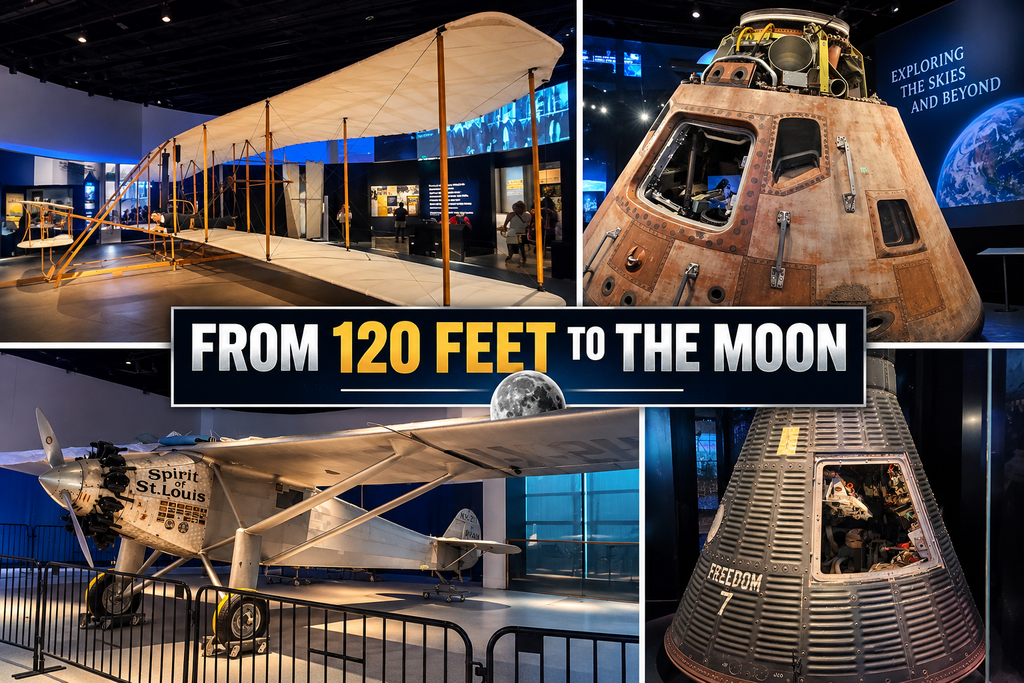
If I had to choose one thing that stuck with me from our visit, it would be the timeline represented by the artifacts inside the museum.
You can essentially walk from Kitty Hawk to the Moon.
Start with a wood-and-fabric airplane that flew 120 feet in 1903.
Move forward six years, and airplanes are entering military service.
Another 18 years, and an airplane is crossing the Atlantic nonstop.
Another 34 years, and an American is riding a rocket into space.
Eight years after that, humans are standing on the Moon.
And then keep going.
Supersonic aircraft.
The Space Shuttle.
Stealth aircraft.
Unmanned aircraft.
Increasingly autonomous flight.
And we’ve had the opportunity during our travels to see a little bit of that continuing story ourselves.
When we visited Starbase, Texas, we were looking at a place where an entirely new generation of spacecraft is being developed.
Even better, we later had the opportunity to watch a Starship launch in person.
There’s something pretty incredible about standing in the Smithsonian looking at the Wright Flyer and spacecraft from the earliest days of America’s space program, and then thinking about standing on the Texas coast watching a Starship thunder into the sky.
We’ve been able to see pieces from both ends of that timeline.
At the Smithsonian, we stood in front of the machine that helped start the age of powered flight and spacecraft that helped take humans to the Moon.
At Starbase, we watched one of the machines that may help determine where humans go next.
And We’re Still Going
The most amazing thing is that this technological revolution didn’t take thousands of years.
It didn’t even take hundreds.
Much of it happened within a single human lifetime.
Imagine showing the Wright brothers a modern jet aircraft.
Imagine explaining a stealth bomber to Charles Lindbergh.
Or telling them that aircraft would someday fly without anyone aboard.
Then try explaining that only 66 years after their little machine struggled into the air above the sand at Kitty Hawk, humans would leave footprints on the Moon.
That’s the part of aviation history that has always fascinated me.
Once we figured out how to fly, we never seemed satisfied with simply flying.
We wanted to fly farther.
Higher.
Faster.
Into space.
To another world.
And now without a pilot onboard at all.
Where aviation goes over the next century is anyone’s guess.
Considering what happened during the first one, I’m not willing to say anything is impossible.
Who knows? Maybe sometime in the next 100 years there really will be an X-wing fighter. If there is, then I’ll be impressed—and I’ll want to see the real one.
Know Before You Go: Smithsonian National Air and Space Museum
Planning a visit to the Smithsonian National Air and Space Museum in downtown Washington, DC? Here are a few things worth knowing before you go.
Admission Is Free
Like the other Smithsonian museums in Washington, DC, admission to the National Air and Space Museum is free. However, the museum may require visitors to reserve a free timed-entry pass, so check the museum’s website before your visit.
Location
The museum is located on the National Mall in Washington, DC, making it easy to combine with several other Smithsonian museums and monuments.
National Air and Space Museum
600 Independence Avenue SW
Washington, DC 20560
We recommend using the Metro or walking rather than trying to drive and park near the National Mall.
Allow at Least a Few Hours
How much time you need really depends on your interest in aviation and space history.
You could see the major highlights in a couple of hours, but if you’re an aviation enthusiast like me and actually stop to look at the aircraft, spacecraft, and exhibits, I’d plan on at least 3–4 hours.
And don’t be surprised if you spend considerably longer standing in front of something like the Wright Flyer or Apollo 11’s Columbia than you expected.
The Museum Is Still Changing
The National Air and Space Museum has been undergoing a massive multiyear renovation, so the galleries and artifacts available today may be different from what we saw during our 2023 visit.
That’s particularly important with this post. The artifacts pictured here are what we were able to see during our visit, but additional galleries have opened since then, and the museum continues to evolve.
Check the museum’s current exhibits, hours, and visitor information before your trip.
Expect Security Screening
Like other Smithsonian museums in Washington, DC, visitors should expect to go through security screening when entering. Traveling light can make getting through the entrance easier, especially during busy periods.
Don’t Try to See Everything
This is probably my biggest recommendation.
You don’t have to read every sign or stop at every display.
Pick the things that interest you.
For me, that meant spending more time with the actual historic aircraft and spacecraft—the Wright Flyer, Wright Military Flyer, Spirit of St. Louis, Freedom 7, Gemini VII, and Apollo 11’s Columbia.
I’d rather spend ten minutes really looking at the Wright Flyer than rush past it because I’m trying to check every exhibit off a list.
Aviation Enthusiast? Don’t Stop Here
If you’re really interested in aviation, the downtown National Air and Space Museum shouldn’t be your only aviation stop.
The Smithsonian also operates the Steven F. Udvar-Hazy Center near Washington Dulles International Airport in Chantilly, Virginia. Its enormous hangars house aircraft and spacecraft that simply couldn’t fit inside the downtown museum.
And if your travels take you to Ohio, we also recommend exploring the Wright brothers’ story at the Dayton Aviation Heritage National Historical Park.
For us, these different sites tell different pieces of the story.
Dayton helps explain how powered flight began. The downtown Smithsonian lets you stand in front of some of aviation’s most important artifacts. And Udvar-Hazy shows you aviation on a much larger scale.
More Aviation & Space Adventures From Our Travels
Aviation and spaceflight are subjects we tend to seek out as we travel. If you enjoyed following the history from the Wright Flyer to Apollo 11 at the Smithsonian, we’ve visited several other places that take different parts of that story much further.
For military aviation: Our visit to the National Museum of the U.S. Air Force gave us the kind of huge aircraft-filled museum experience that I particularly enjoy as an aviation enthusiast.
For naval aviation: We also explored the National Naval Aviation Museum, where the focus shifts to the aircraft, people, and history of U.S. naval aviation.
For the beginning of powered flight: Our visit to Dayton Aviation Heritage National Historical Park takes the story back to Wilbur and Orville Wright and the work that eventually put the Wright Flyer into the air.
For America’s human spaceflight story: At the Johnson Space Center, we explored another side of the Mercury, Gemini, and Apollo story represented by the spacecraft here at the Smithsonian.
And for what may come next: We’ve even taken our RV travels to Starbase, Texas, and had the opportunity to watch a Starship launch.
That’s one of the things I love about following aviation history as we travel. We’ve been able to visit places connected to where powered flight began, see the actual machines that took humans to the Moon, and stand on the Texas coast watching the next generation of spacecraft leave the launchpad.
Want to See More of Washington, DC?
The Air and Space Museum is only one stop on the National Mall. If you have limited time in Washington, a guided tour can be an easy way to see several of the city’s major monuments and historic sites without trying to plan everything yourself.
See Washington, DC Tours on Viator →
Our Thoughts After Visiting
If you’re an aviation enthusiast visiting Washington, DC, the Smithsonian National Air and Space Museum belongs on your itinerary.
Just go into it knowing what makes this museum special.
I wouldn’t necessarily call it the best air museum we’ve visited.
But some of the aviation and space artifacts inside may be the best you’ll ever get the opportunity to see.
That’s an important distinction.
I could happily skip the X-wing and Star Trek’s Enterprise. But give me another chance to stand in front of the original Wright Flyer, study the Spirit of St. Louis, peer inside Gemini VII or look at the scars covering Apollo 11’s Columbia, and I’m there.
Because ultimately that’s what I want from an aviation museum.
I want to see the airplanes. I want to see the history. And whenever possible, I want to see the real thing.
At the Smithsonian National Air and Space Museum, there is an incredible amount of the real thing under one roof.
What Piece of Aviation History Would You Want to See?
For me, it’s hard to beat standing in front of the actual Wright Flyer and realizing that little airplane helped start everything that followed.
What about you? Have you visited the Smithsonian National Air and Space Museum? Which aircraft or spacecraft impressed you the most?
Or, if you haven’t been yet, what’s the one piece of aviation or space history you’d most want to see in person?
Tell us in the comments below—we’d love to hear your pick.